Kitchen Exhaust Cleaning in Guelph
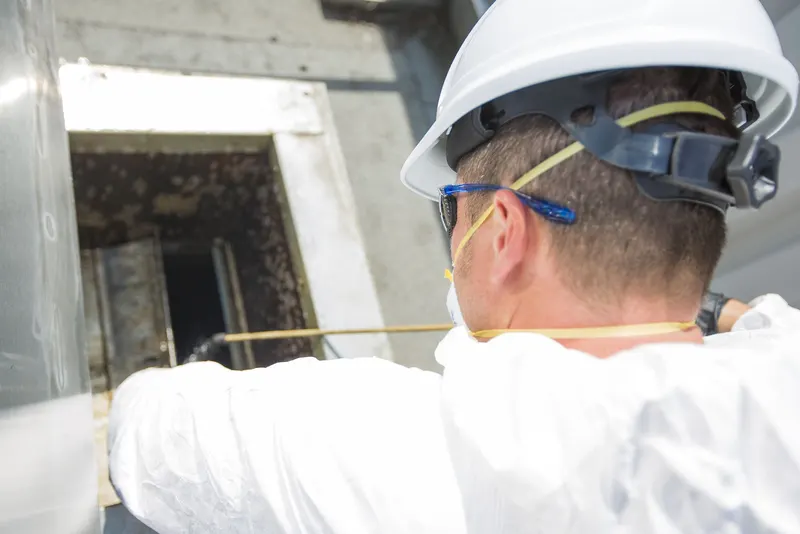
Kitchen Exhaust Cleaning in Guelph is the service that picks up where a hood clean stops: the grease duct that leaves the collar above the plenum, crosses the ceiling space, climbs the riser and reaches the fan on the roof. Guelph Hood Cleaning opens every access panel on that path, scrapes each section back to bare metal, measures grease depth against the NFPA 96 limit of 0.078 inches at the collar, the elbows, the foot of the riser and the fan inlet, and photographs each section for a signed health and safety certificate referencing the published standard. A plaza kitchen on Stone Road that shares a riser with its neighbours gets a quote that says which section belongs to whom.
Horizontal run, riser and access panels: what kitchen exhaust cleaning covers after the hood
The horizontal run starts at the duct collar on top of the plenum and crosses the ceiling space toward the shaft. Air slows as it travels, so grease settles on the duct floor and piles against the outside wall of every elbow. In a long single-storey building, such as a plant cafeteria off Woodlawn Road, that run can cross half the roof before it turns upward.
The riser is the vertical section up to the fan. Grease that condenses on its walls runs back down and pools in the turn at the bottom, so a riser that looks clean from the roof can hold its thickest layer at the foot.
Access panels are gasketed openings cut into the duct wall so each section can be reached, scraped and photographed. A run with no panel cannot be cleaned or measured past the collar. Fitting panels is priced on the quote before the visit. The canopy, filters and plenum are on the hood cleaning services page, and the fan itself is on the exhaust fan repair page.
Hood-only vs full-system kitchen exhaust cleaning services in Guelph
The two scopes look identical from the kitchen floor and read very differently on the record an inspector or an insurer asks for.
| What the record has to show | Hood-only vs full-system: the hood-only record | The full-system record |
|---|---|---|
| Was the run above the ceiling opened? | No. The collar was wiped from underneath. | Yes, at every panel, with a dated photograph inside each one. |
| Was the foot of the riser cleaned? | Not reached. | Yes. The pooled layer in the turn is scraped out and photographed. |
| Where was 0.078 inches checked? | Canopy and plenum. | Collar, every elbow, the riser foot and the fan inlet. |
| Whose name is on the shared riser? | Nobody. The riser is not mentioned. | The building, on its own quote. The tenant certificate says where the branch ends. |
| What does the certificate list? | The hood. | Every section cleaned, and every section not reached, with the reason. |
The published intervals and what the certificate asserts are on the NFPA 96 page.
Best commercial kitchen exhaust cleaning in Guelph for a Stone Road or Woodlawn Road plaza with a shared riser
Guelph Hood Cleaning documents each unit to the junction and quotes the riser itself to whoever owns the building.
The retail plazas along Stone Road, Woodlawn Road and Speedvale Avenue were built with two or three food units venting into one riser. A pizza franchise, a sandwich franchise and a dairy franchise can share a shaft, and each one holds its own certificate while the riser above them loads from all three with nobody named on it.
The split gets written down before the truck arrives. Each unit owns its canopy, plenum and branch duct up to the junction. The riser and the fan belong to the building. The tenant certificate states where the branch ends, and a separate riser quote goes to the property manager with proof of WSIB coverage and liability insurance. Where the landlord declines, the tenant record says so, and that line is the one an inspector reads first.
Hood filters: filter cleaning and filter replacement between duct visits
Filter condition sets how fast the duct loads, so every kitchen exhaust visit starts at the filter slot.
A clean, seated baffle filter turns the air and drops grease into the trough. A filter that is bent, missing or clogged sends the plume straight into the plenum and on down the run, and the duct then carries in months what it should carry in a year. Every certificate notes the condition of the set.
Filter cleaning between visits is a staff job: a weekly pass through the dish machine keeps the surface film off. Filter cleaning on the visit is the heated soak tank on the truck, which lifts the cooked-on layer the dish machine leaves in the folds. Filter replacement goes on the written quote when a blade is bent, a frame is rusted through, a filter is missing from the slot, or the slot still holds mesh in place of baffles.
One paragraph on the metal is enough here. Aluminum baffles darken and pit under caustic degreaser over repeated soaks; stainless baffles do not, which is why a fryer line that gets cleaned on a quarterly interval is usually quoted stainless. Either type is sized to the slot, never trimmed to fit. Baffle against mesh, and the soak tank itself, are on the hood cleaning services page.
Measuring 0.078 inches along the whole path, not at the hood
NFPA 96 sets the acceptable grease depth at 0.078 inches, and the limit applies to every surface the cooking air touches.
Four points get measured on every full-system visit in Guelph: the collar, where the airstream first slows; the outside wall of each elbow, where grease is thrown by the turn; the foot of the riser, where everything above drains to; and the fan inlet, the last surface before discharge and the one most often skipped. A depth gauge and a photograph go on the record at each point.
A section with no panel is not measured and is not on the certificate. It goes on the record as not accessible, with the panel needed to fix it, so a facilities manager or a franchise owner can see exactly what the next visit has to add.
Creosote in a wood-oven duct: why a solid-fuel line in Guelph is scraped, not sprayed
Commercial kitchen exhaust cleaning behind a wood-fired oven deals with two deposits at once.
A gas line sends grease up the duct. A wood oven sends grease and smoke, and the smoke leaves creosote, the tarry residue that condenses on any surface cooler than the fire. Creosote glazes the duct walls, the grease soaks into it, and the mix sets harder than grease alone, ignites at a lower temperature, and shrugs off a fryer-duct degreaser.
A downtown pizzeria that runs a wood oven therefore sits on the shortest interval NFPA 96 publishes, and its duct is scraped by hand rather than sprayed. The walk-through records whether the oven vents on its own duct or shares the run with the gas line, and solid-fuel duct work is quoted per job after it.
Where to find commercial kitchen exhaust cleaning near me in Guelph
Guelph Hood Cleaning traces duct runs across Guelph, Fergus, Elora, Rockwood, Erin, Arthur, Puslinch, Minto and Mount Forest at one price list.
Shared risers belong to the Stone Road, Woodlawn Road and Speedvale Avenue plazas. Long horizontal runs with few panels belong to the plant cafeterias of the Hanlon Creek Business Park and the Northwest Industrial Park. Tall risers belong to campus and hospital kitchens. Short single runs belong to the church halls and legion kitchens of Fergus, Elora, Rockwood, Erin, Arthur, Minto and Mount Forest, where a duct that has never been opened is common. The corridor detail is on the areas served page, and Centre Wellington has its own page.
How much does kitchen exhaust cleaning cost in Guelph in 2026?
Guelph Hood Cleaning prices a single-hood kitchen up to ten feet from $585 per visit and a multi-hood kitchen of two to four canopies from $995 per visit. Shared-riser and larger systems are quoted on site after a free walk-through, with the written quote back within 24 hours.
On a full-system job the duct sets the hours: run length, elbow count, riser height and the number of usable panels all move the figure. New panels are their own line on the quote. A shared riser is quoted to the building separately from the tenant branch. A wood-oven duct is quoted per job after inspection because the creosote layer sets the hours.
Next step: call 226-641-5901 or request a written quote. Say whether the unit shares a wall with another kitchen and whether a duct panel has ever been opened. The other services are on the services page.
Kitchen exhaust cleaning services in Guelph: frequently asked questions
Who pays for the shared riser in a Stone Road or Woodlawn Road plaza?
The building, under most leases. The riser and the fan are common elements, and each tenant is responsible for its own hood and branch duct. Guelph Hood Cleaning quotes the tenant branch and the building riser as two separate documents.
How many access panels does a duct run need?
One near the collar, one at each change of direction, and one at the foot of the riser, so that every section can be reached. A run that has never been opened usually has one or none.
Does the visit include cleaning the hood filters?
Yes. The filters come out first and go into the heated soak tank while the duct is opened. Replacement filters are quoted in writing, never swapped without approval.
Is the 0.078 inch limit different for the duct than for the hood?
No. NFPA 96 applies the same depth everywhere the cooking air travels. A layer that fails the plenum fails an elbow or the riser foot. The standard itself is on the NFPA 96 page.
How is a plant cafeteria off Woodlawn Road different from a downtown restaurant?
The run. A single-storey plant sends the duct across a long ceiling space with few panels, while a downtown building sends it up a short riser. Panels get priced on the quote, and the certificate names each section reached.