Commercial Kitchen Deep Cleaning in Guelph
Commercial Kitchen Deep Cleaning in Guelph is the fire-prevention degreasing of the cooking area that the exhaust hood does not cover: the walls and ceiling around the line, the floor under the equipment, the outside of fryers, ranges and ovens, and the narrow gap behind them where grease collects for years. A hood cleaning removes the fuel inside the exhaust path. A deep clean removes the fuel outside it. Guelph Hood Cleaning quotes each deep clean per job after a free walk-through, works overnight or between services, and photographs every surface before and after. The written quote comes back within 24 hours.
Commercial kitchen cleaning services in Guelph: what a fire-prevention deep clean covers
A commercial kitchen deep clean from Guelph Hood Cleaning is fire-prevention degreasing, not a janitorial, floor-care, disinfecting or sanitation contract. It covers five zones around the cook line.
Walls behind and beside the line. Grease vapour that escapes the hood drifts sideways, cools and sets on the wall tile. On a fryer-heavy line downtown it builds a tacky amber film in a single season.
The ceiling above the line. Warm vapour rises past the edge of the canopy and settles on the ceiling panels. Nobody looks up, so it is usually the thickest deposit in the room.
The floor under the equipment. Fryer oil, drips and mop water run under the line and stay there. The square metre under a range is often the dirtiest in the building, and no mop reaches it.
Equipment exteriors. The sides of the fryers, the back panel of the range, the top of the salamander, and the legs and casters of everything on the line.
The gap behind fryers and ranges. A few centimetres between the back of the appliance and the wall, packed with grease, food debris and packaging, next to an open flame every service.
Deep clean vs nightly clean in Guelph: what the closing crew cannot reach
Nightly cleaning is not the problem. The closing crew on a Gordon Street restaurant does what a closing crew can do in forty minutes with the line in place. A deep clean is what happens when the line comes out from the wall.
| Surface | Nightly clean vs deep clean | What the deep clean changes |
|---|---|---|
| Wall tile behind the range | Nightly: wiped to arm's reach with the range in place | Range pulled out, wall degreased from the floor to the ceiling line. |
| Floor under the fryers and ranges | Nightly: mopped to the front edge of the line | Line rolled out, floor scraped and degreased to the wall. |
| Ceiling panels above the line | Nightly: not touched | Degreased panel by panel, from the canopy edge outward. |
| Fryer and range exteriors | Nightly: front face wiped | Sides, back panel, legs and casters degreased on every face. |
| Gap behind the appliances | Nightly: unreachable | Cleared of debris, scraped and degreased. |
Restaurant equipment cleaning in Guelph: fryers, ranges and the space behind them
Restaurant equipment cleaning on a deep clean means the outside of the appliances and the surfaces they hide. The inside of the fryer vat and the oven cavity stay with the kitchen, on its own schedule.
Fryers are shut off at the gas valve or unplugged, rolled out, and degreased on every face. Ranges are pulled far enough to reach the back panel and the wall behind it. A steamer line on a franchise strip along Stone Road carries grease in water vapour without any visible flame, and the load on its wall and ceiling surprises most franchisees on the first walk-through. A church hall kitchen in Fergus that runs a few meals a week has less deposit per month but more years of it, because nobody has ever pulled the range.
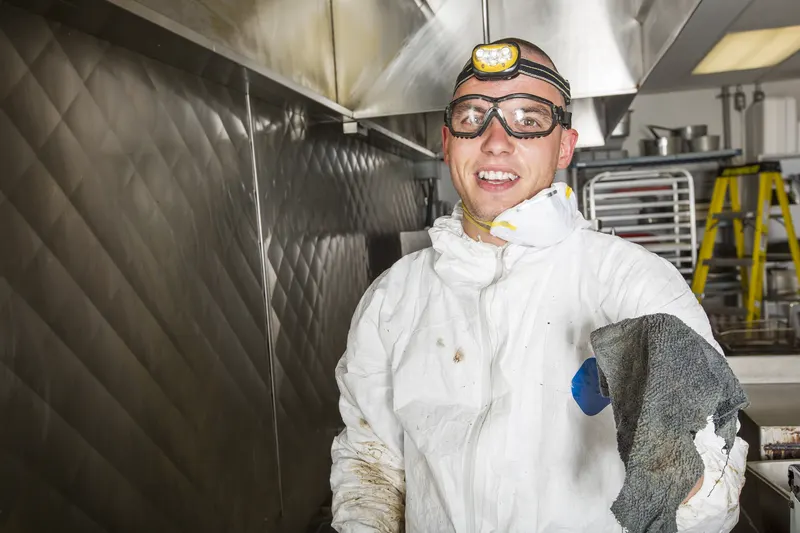
Every piece goes back where it came from, reconnected, with the gas valve and the casters checked. Nothing is moved that the kitchen has not agreed to move on the walk-through, and every surface is photographed before and after.
Why a fire inspector reads grease on a wall the same as grease in a duct
Grease is fuel wherever it sits. The exhaust path gets measured against a published limit, and the NFPA 96 guide covers the depth and the intervals. The wall beside the burner is not measured, but it burns the same way.
An inspector from the Guelph Fire Department, or from Centre Wellington Fire Rescue in Fergus and Elora, walks a kitchen with the Ontario Fire Code in hand and does not stop reading at the hood. A wall coated behind a range, a gap packed with debris beside an open burner, or a floor slick under a fryer is a fuel load sitting next to an ignition source. Wellington-Dufferin-Guelph Public Health inspects the same kitchen for food safety and sees the same wall. An insurer asks about the same wall after a fire.
A deep clean removes that fuel load and leaves photographs of every surface, so the kitchen has a dated record for the fire service, public health, the landlord and the insurer, in the same folder as the hood cleaning certificate.
Best time for commercial kitchen deep cleaning in Guelph: pairing it with a hood visit
The most efficient night for a deep clean is the same night as a hood cleaning, because the line is already shut down, the floor is already covered, and the crew already has the degreaser mixed.
A church hall in Fergus or a community kitchen in Rockwood that runs a few services a week usually pairs its one deep clean with its annual hood visit. A campus or plant cafeteria that serves lunch five days a week tends to book the deep clean for a term break or a plant shutdown. A downtown restaurant books it for a Sunday overnight. Overnight and between-service scheduling is the default, not the exception.
Hood, duct and fan work has its own pages: hood cleaning services, kitchen exhaust cleaning and exhaust fan repair and installation. A deep clean can be booked with any of them or on its own.
How much does commercial kitchen deep cleaning cost in Guelph in 2026?
Commercial kitchen deep cleaning in Guelph is quoted per job after a free walk-through, with the written quote back within 24 hours. The price follows the length of the line, how many pieces have to come out from the wall, and how long the walls and floor have gone without a degrease. For context, a scheduled hood cleaning visit starts from $585 per visit for a single-hood kitchen up to ten feet and from $995 per visit for a multi-hood kitchen of two to four canopies.
Every deep clean comes with before-and-after photographs of every cleaned surface, and proof of WSIB coverage and liability insurance arrives before work starts. The other services are on the services page, and the kitchen types are on the who we serve page.
Next step: call 226-641-5901 or request a written quote. A photograph of the line from the front and one of the wall behind a fryer is enough to scope the visit.
Commercial kitchen deep cleaning in Guelph: frequently asked questions
Is a commercial kitchen deep clean the same as a janitorial contract?
A commercial kitchen deep clean is a one-visit fire-prevention degrease of the surfaces around the cook line. It is not a janitorial, floor-care, disinfecting or sanitation contract, and it does not replace the nightly close.
Does the kitchen have to shut down for a deep clean?
The cook line has to be cold and empty for the hours the crew is on it, which is why the work runs overnight or between services. The dining room and the rest of the building stay untouched.
Who moves the fryers and ranges?
The crew moves them. Gas is shut off at the valve, the piece is rolled out, cleaned, rolled back and reconnected, and the walk-through settles in advance which pieces are on the list and which are not.
Does a deep clean include the inside of the fryers and ovens?
A deep clean covers the outside of the appliances and the surfaces around and beneath them. Fryer vats, oven cavities and griddle tops stay on the kitchen's own daily and weekly schedule.
How often does a Guelph kitchen need a deep clean?
NFPA 96 publishes intervals for the exhaust path, not for the walls and floor, so the deep clean interval is set on the walk-through. Most kitchens pair it with a hood visit, and a fryer-heavy line needs it more often than a church hall.